

Machig Labdron, 24″x30″ (61×77 cm) , 33″x57″ (85×145 cm) with brocade, © 2005 Leslie Rinchen-Wongmo
It’s Not So Obvious: a lesson in the need for explanation
I recently lent my Green Tara thangka to a dharma center to decorate their hall during a teaching. It was an honor seeing the thangka on the wall behind the lama as he shared his precious wisdom. And it filled me with joy to know that this thangka will one day reside in the dharma hall of the Tibetan Meditation Center in Escondido, where it will accompany many profound teachings.
When the session was finished, I helped the organizers to take down the thangka so that I could carry it home. I had not participated in the set-up and was surprised to find that the thangka had been suspended by the fine string made for holding the silk drape, rather than by the robust straps intended for the purpose. Fortunately, no harm was done. But this experience made me realize how easy it is to assume that others know what we, in our unique experience, have learned. It’s not at all obvious how to hang a thangka — nor how to roll it up for transport, nor how to arrange the silk drape. Some explanation might be useful.
Thangka conservator Ann Shaftel provides a useful diagram of the parts of a thangka in her insightful article, Intent, In Tents and Intense. (Several of Ann’s articles are also available in Italian here.)
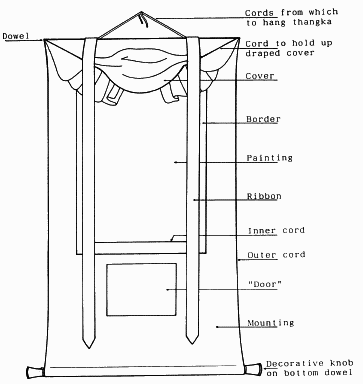
Not every thangka will exhibit all these parts.
For example, many do not contain the “door” in the lower part of the brocade mounting.
I have omitted the dangling silk ribbons on my more recent thangkas.
And sometimes the cords from which to hang the thangka will be replaced by a string at the back or top of the upper dowel. This is what confused the organizers of that recent teaching where my Green Tara was displayed. Their other thangkas had such a string, whereas I had never seen thangkas without the dual-purpose cords which serve alternately for hanging the thangka and for keeping it rolled up.
How to Hang a Thangka
Now for the explanation you’ve been waiting for:
Assuming your thangka has the standard cords or straps that keep a rolled-up thangka rolled up, unwrap these and tie them together (as shown at the top of the diagram above). I suggest tying in a bow rather than a knot, to facilitate later untying and re-rolling.
Place one hook or nail in the wall at a height which will place the heart of the deity above your eye level. As a sign of respect and to enhance the inspirational quality of the image, you’ll want to look upwards to it.
Hang the tied cords (or, in their absence, the string at the back or top of the upper dowel) over the nail.
Let the thangka unroll slowly, controlling its fall with your hands.
When the thangka is fully extended and level, gather the silk cover in your hand and tuck it under the string or fine cord at the front of the upper dowel, creating a decorative flourish.
Great clarifications Leslie, thanks. What are the ribbons for though? I never understood that.
How interesting! Thanks for explaining this. Aahh – wouldn’t that thangka look great above the mantel in my meditation/yoga room?!
Glad you like the thangka, Anna. 🙂
Louise, I’m really not sure what those ribbons are for, other than decoration… And I usually end up tucking them behind so that they don’t obscure the image. So, in the end, they don’t even decorate! It’s one of the many questions on my list. I’ll let you know if I solve it one day.
This is definitely a great point you have talked about. I am certainly looking forward to giving it a go by myself and determine if I have your identical outcome.
Thanks for this useful and clear instruction; thankfully the internet allows us access to such dharma ways!
Blessings!
The word thangka comes from the Tibetan “thang yig”, which mean
Blessings!
Thanks for a very well-written post on the subject. Very useful and insightful tips for the proper hanging and attitude towards the thangkas.
Also thanks to Diane for the precise remarks.
May all beings benefit!
Thank you for the directions. Do you know when you will be describing in illustrated detail how to arrange this cover drape? This seems to be the most difficult part.
Hi Spencer!
I’ve posted directions on how to arrange a thangka’s silk drape here:
https://threadsofawakening.com/how-to-arrange-the-draped-silk-thangka-cover
I’m also planning to make a video demonstration soon. Sign up for weekly wake-ups to receive notification when that video becomes available.
Thank you for this information. We were lucky to purchase a beautiful Thangka at an estate sale. It does not seem to have any pockets to the pole of cord attached. Someone had foolishly folded it in half.
What do you think would be the best way to make the pockets for the poles? I would appreciate your advice.
Hi Risa!
Sorry to hear someone folded your thangka in half! For a painting, that can’t be good!
Without a photo, I’m not exactly sure what part is missing from your thangka’s frame. It sounds like you may want to have it re-mounted in brocade or (maybe better) mounted in a frame, behind glass. Otherwise, you’ll have to find someone with sewing experience and ingenuity who can add some kind of fabric tunnel or loops through which to insert rods and the top and bottom of the brocade frame. A quilter or other textile artist who makes hanging pieces may be able to help you. Where are you located? Can you visit a quilting store or group in your area and ask them?
I have a beautiful Medicine Buddha thangka. Is it ok to hang this at the head of my bed, or is that inappropriate?
Thanks
Hi Caryl,
Thanks for reaching out. Where did you get your beautiful Medicine Buddha thangka? What does it mean to you?
Some people think the bedroom is not a proper place for a thangka. But it really depends on your attitude and care. The key point is to treat the image with respect, like an honored guest, because it represents both a precious teacher and your own highest potential.
I was taught not to hang buddha images near the toilet or to put them on the floor or anywhere you might sit on them. Some people think that having sex in front of the images is disrespectful, hence they advise against putting them in the bedroom. Some even believe that undressing in front of the image is disrespectful, because normally you would put on your best attire to welcome a respected guest. On the other hand, having the Buddha image in your dressing space might encourage you to be more attentive and caring as you engage in the mundane activity of dressing.
Generally, in Asian culture, it’s considered disrespectful to point your feet at anyone, especially at a teacher, so I would not recommend hanging a thangka at the foot of your bed. But putting sacred images above the head is generally considered a respectful acknowledgment. So hanging your Medicine Buddha over the head of your bed could be just right for you. Think about it. Consider deeply. And then make the choice that feels most nourishing to you and your practice. There’s no absolute right or wrong here.
Hope that helps!
Hello, Leslie.
I live in a weird studio apartment with only one big window (sliding glass doors like patio). If I cover the window or a portion of it with drapes or a wooden partition, is it okay to hang a thangka over the window?
Thanks,
Nicholas
Hi Nicholas,
I don’t see any problem with hanging a thangka over a window, but are you sure you want to cover your only window? Thangkas are inspiring, but so is sunlight. Do you have any wall space you could use instead?